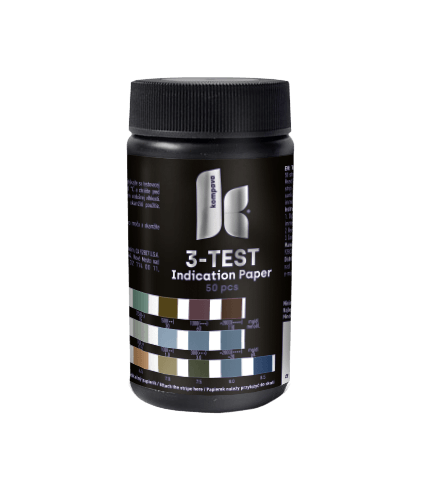
How to correctly measure the concentration of substances in urine?
Measure the values from your morning urine and follow the rule of the so-called midstream urine. This means that you let some of the urine flow out and only then take a sample or directly wet the test strip. Place the test strip on absorbent paper, which will absorb the excess urine, and after about 60 seconds, evaluate the color of the reagent zones according to the color scale on the box.
One of the functions of the kidneys is to regulate acid-base balance, so any deviation can signal a number of diseases. Deviations from this value may be associated with urinary tract infection and are also a risk factor for the development of urinary stones (both high and low pH), urogenital tract disorders, acidosis (over-acidification), etc.
Evaluation of values from indicator paper
Glucose in urine
If, after approximately 60 seconds, the indicator strip does not change color when checking glucose in urine after comparison with the color scale, the result is negative – this means that there is no glucose in the urine and the result is normal.
If the strip turns green or a darker shade, this may indicate the presence of sugar in the urine. In this case, it is advisable to see a doctor and have your blood glucose level checked to rule out or confirm diabetes or other health problems.
Protein in urine
A similar principle applies when checking for protein in urine. If the paper does not change color, there is no protein in the urine or only a minimal physiological amount.
However, if the strip changes color, it may mean that the kidneys are not filtering the blood effectively enough. Healthy kidneys retain protein in the blood and allow only a very small amount to pass into the urine. Increased protein in the urine may indicate:
- impaired or disrupted kidney function,
- inflammation or infection of the urinary tract,
- temporary stress on the body (e.g., fever or intense physical exertion).
If protein appears in the urine repeatedly or in higher amounts, it is advisable to see a doctor and undergo further tests to determine the exact cause.
Determining urine pH
The third value on the indicator strip is used to determine the pH of urine.
The pH value of urine normally ranges from approximately 4.5 to 8. Our indicator strips allow you to measure the pH in the range from 5.0 to 8.5.
If the strip turns to a value of 5.0, it means that the urine is acidic. This may not be a problem in the short term (e.g., due to diet), but a low pH over a long period of time may indicate an imbalance in the body.
A slightly acidic range of approximately 5.5–6.5 is considered physiological, i.e., the natural environment of urine. Values between 6.5 and 7.0 are often referred to as optimal—a slightly neutral environment that is well tolerated by most people.
If the strip shows a value higher than 7.0, the urine is alkaline. In this case, the urine pH is high.
If the urine pH is low or high for a long time, it is advisable to consult a doctor and consider a more detailed examination.